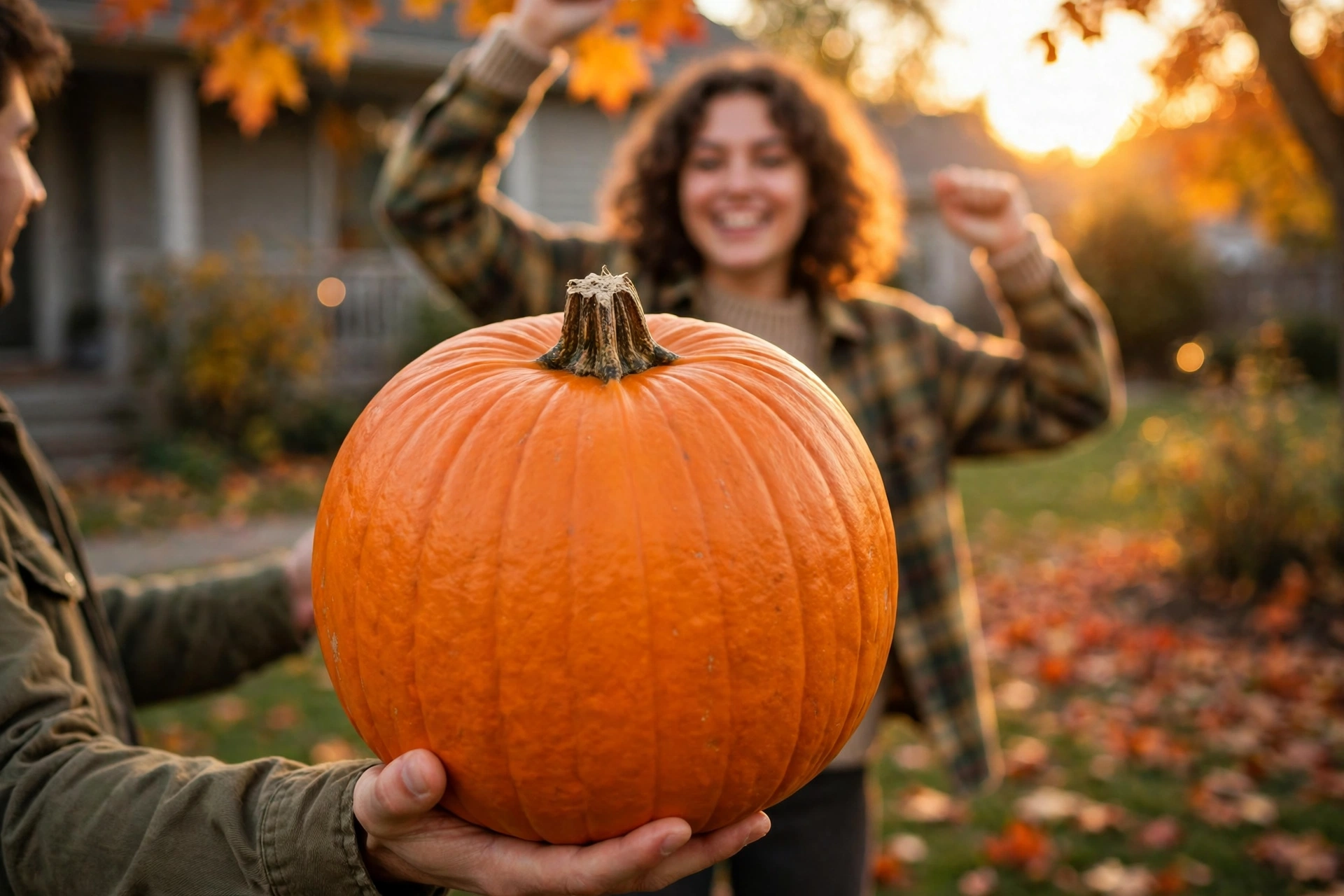
Last weekend I watched my neighbour’s kid run around the front yard with a pumpkin on his head, and for about ten seconds I thought the whole street had lost it. Then I opened Instagram and realised he wasn’t being weird at all. He was just early. My feed was suddenly full of people whose heads had apparently turned into pumpkins, dancing around like nothing was strange, and every single one of those videos had the same joke: the pumpkin stays perfectly still while the body underneath goes completely wild.
That is the Pumpkin Head Illusion, and honestly, it might be the easiest Halloween format of the year. No costume to buy, no editing degree needed, and no app you have to learn from scratch. You need one pumpkin, one friend, and a phone. I filmed my first one in about fifteen minutes, and the second one took half that time because I finally understood where everyone was going wrong with the setup.
Here is the whole thing, the way I actually did it, including the mistake that ruined my first take.
What the Pumpkin Head Illusion actually is
The trick is forced perspective, which sounds fancy but is really just a camera cheat. One person holds a real pumpkin right up against the phone lens. A second person stands a few steps behind them. From the camera’s point of view, the pumpkin lines up exactly where the second person’s head should be, so it looks like they have a pumpkin for a head. Then the person in the back dances, spins, waves their arms around, and generally acts like a maniac, while the pumpkin itself never moves.
That contrast is the whole joke. A still, slightly smug-looking pumpkin on top of a body that cannot sit still. People stop scrolling because their brain takes a second to work out what it is looking at, and by the time they figure it out, they are already watching the dance.
It works on Reels, TikTok, and Shorts without changing anything, and it fits the Halloween wave without needing a full costume. If you have already been following the October 2026 Instagram Reels trends, you will notice this one sits right alongside the other simple, prop-based formats of the month. It is in the same family as the GRWM Loading Reel and the Upside Down Reels trend: one clear idea, filmed in one place, with the payoff visible in the first two seconds.
What you need before you film
Keep this list short, because the format punishes over-preparation. I have seen people try to storyboard this and it just kills the energy.
- One medium pumpkin, not the biggest one at the patch. A pumpkin around the size of a basketball is perfect. Anything bigger gets heavy fast, and your arm will start shaking by take three.
- A phone with a decent camera. Any recent iPhone or Android works. You do not need a fancy lens.
- A friend who is willing to look silly. This is non-negotiable, and it is also the hardest part of the whole production.
- Outdoor light, ideally golden hour. That last hour before sunset makes the orange pop in a way midday sun just does not.
- A tripod or a stack of books if you want a locked-off shot, though honestly a third friend holding the phone works just as well.
One thing I got wrong the first time: I picked the heaviest pumpkin at the store because it looked impressive. Ten seconds into holding it at arm’s length in front of the lens, my arm was trembling, and the pumpkin was bobbing up and down like it was nodding along to the music. Funny in retrospect, useless as a video. Medium pumpkin. Trust me on this one.
Setting up the shot, step by step
1. Pick your spot and your light
A porch, a front yard, a driveway with some autumn leaves on it, or a park path all work. You want a background that reads as “autumn” without trying too hard. Avoid busy backgrounds like a parking lot full of cars, because the viewer’s eye should go straight to the pumpkin.
Face your subjects toward the light if you can, so the pumpkin is lit and the person behind is not a silhouette. If the sun is behind them, the pumpkin turns into a dark orange blob and the illusion falls apart. I filmed my good take with the sun low and off to one side, and the difference from my backlit first attempt was night and day.
2. Position the pumpkin holder
The person holding the pumpkin stands closest to the camera, about an arm’s length from the lens. They hold the pumpkin by the stem or cradle it from underneath, right in front of the lens, and then they step slightly to one side so their own body is mostly out of frame. Their only job after that is to be a human tripod: hold still, keep the pumpkin level, and do not laugh. Laughing shakes the pumpkin, and a shaking pumpkin head ruins the joke.
If your arms get tired, rest your elbows on something, or have the holder sit on a stool. Nobody can tell from the video, and your takes will get dramatically better.
3. Position the dancer
The dancer stands three to five steps behind the pumpkin holder. The exact distance depends on the pumpkin size and how tall your dancer is. The goal is simple: when you look at the phone screen, the pumpkin should sit exactly where the dancer’s head would be. Move the dancer forward or back until the pumpkin covers their head completely, with their shoulders starting just below it.
Do a test frame before you record. Take a photo first. If you can see the dancer’s forehead peeking out above the pumpkin, they need to step back or crouch slightly. If there is a big gap between the pumpkin and their shoulders, they need to step forward. Get this right in the photo and the video will take care of itself.
4. Film it in one take
Hit record and let the dancer go. Spinning, arm flailing, goofy dance moves, pretending to be a zombie, all of it works. The pumpkin stays still, the body does the comedy. Keep the clip between ten and twenty seconds. That is long enough for the joke to land and short enough that people watch it twice, which is exactly what you want for how to increase views on Reels.
Film three or four takes back to back while everyone is still in position. Your first take will almost never be the best one, because the dancer is still warming up and the holder is still figuring out how still they need to be. My third take was the one I posted. The first two were practice, and I am glad I did not delete them, because watching them back taught me what to fix.
Editing it in CapCut
Here is the good news: this format needs almost no editing, which is why it is spreading so fast. But a couple of small touches make it look intentional instead of accidental.
Open CapCut, import your best take, and trim the dead second at the start where someone says “are we recording?” Cut straight to the dancing. If you want, add the spooky remix of the “it’s just a bunch of hocus pocus” line that a lot of creators are using for this format. Always check the sound is actually available in your app before you build the whole video around it, because sounds disappear or get restricted by region, and there is nothing more annoying than finishing an edit and finding the audio gone.
Keep on-screen text minimal. A single line at the start, something like “he wanted to be a pumpkin for Halloween,” is plenty. The visual is doing the work, and covering it with paragraphs of text just hides the joke.
If you are already comfortable with CapCut from other formats, the Crumpled Paper Reel workflow is a useful comparison: same idea of one strong visual, minimal cuts, and letting the format speak. The Getting Robbed Reel works the same way too. One joke, filmed cleanly, edited lightly.
Variations that keep it fresh
Once you have the basic version, there are easy ways to make yours different from the fifty other pumpkin heads on someone’s feed.
- The pumpkin family. Film three dancers in a row, each with a pumpkin held in front of them, so you get a whole row of pumpkin-headed dancers. It takes two holders and a wider frame, but it looks great.
- The costume upgrade. Put the dancer in a simple costume, a witch hat below the pumpkin, a skeleton onesie, anything that adds a second layer to the joke.
- The reveal. Film the dancer normally for two seconds, then have the pumpkin drop into frame from above to “replace” their head on the beat. It takes a couple of tries to time it, but the reaction in the comments is worth it.
- The pet version. If your dog will sit still for ten seconds, and that is a big if, a pumpkin held in front of a sitting dog gets an outsized reaction. My dog lasted four seconds before walking off, and I still almost posted it.
- The porch at night version. String lights behind the dancer, pumpkin lit from the side with a phone flashlight, and you get a moodier version that stands out from all the daylight takes.
Mistakes that ruin the illusion
I made most of these, so you do not have to.
Holding the pumpkin too far from the lens. If the holder stands too far back, the pumpkin looks small and you can see the dancer’s real head behind it. The pumpkin needs to be close to the camera. That is the whole trick.
A shaky pumpkin. Tired arms, laughing, or a holder who keeps peeking around the pumpkin to watch the dancer. All of it shows up on camera. Rest your arms, pick a smaller pumpkin, and accept that the holder’s job is boring.
Filming at noon in harsh sun. Hard shadows across the pumpkin make it look flat and weird. Golden hour or open shade is far more forgiving.
Over-editing. I have seen versions with five transitions, three text animations, and a filter that turns everything orange. The format does not need any of that. Every effect you add is attention taken away from the joke.
Forgetting permission at pumpkin patches. This one matters. Pumpkin patches are working farms, not public parks. If you film at one, buy the pumpkin you use, ask before you set up, and stay out of roped-off areas. A porch pumpkin works just as well and nobody has to ask anyone anything.
Posting without checking the sound. Sounds get removed, restricted, or replaced. Check the audio in-app on the day you post, not the day you filmed.
Why this format works right now
Halloween formats have a short, sharp window. People start looking for them in mid-October, and by November 1 the moment is gone. That is actually good news for small accounts, because viewers are actively searching for Halloween ideas and the algorithm has a seasonal reason to show them. The Pumpkin Head Illusion also has two things working in its favour: it is instantly readable in the first second, which matters for watch time, and it is easy to copy, which matters for shares and remakes.
None of that is a promise that your version will go viral. Nobody can promise that, and anyone who does is selling you something. What I can say is that the format gives you a fair shot: a clear joke, a fast setup, and a seasonal reason for people to be looking for it. The rest comes down to your timing, your dancer’s commitment to looking ridiculous, and whether you post it while people are still in Halloween mode.
If you film it this week, post it before Halloween weekend, not after. Seasonal formats age like milk, and a pumpkin head on November 3 is just a person holding a vegetable.
A quick filming checklist
- Medium pumpkin, basketball-sized, bought not borrowed from a display
- Phone charged, storage free, lens wiped (a smudged lens kills autumn light)
- Dancer briefed: go big, the camera loves overacting here
- Test photo taken, pumpkin fully covering the dancer’s head
- Three to four takes filmed back to back
- Best take trimmed in CapCut, dead air cut from the start
- Sound checked in-app on posting day
- One line of text maximum, or none at all
- Posted before Halloween, not after
That is the whole format. One pumpkin, one friend, fifteen minutes, and a video that looks like you tried much harder than you did. Go film it while the pumpkins are still on the porches.
Frequently asked questions
Do I need two people, or can I film it alone?
You really need two people, or one person plus a tripod trick. One person holds the pumpkin and the other dances. A solo version with a tripod and a timer is possible but fiddly, because you have to run back and forth between positions.
What size pumpkin works best?
Basketball-sized. Big enough to cover a head on camera, light enough to hold still for thirty seconds.
Does it work indoors?
Yes, if you have enough space between the holder and the dancer and decent light. A hallway or living room with a plain wall works fine. Outdoors looks better, but indoors is not a dealbreaker.
Can I use a fake pumpkin?
A plastic or foam pumpkin works and is lighter, which solves the shaky-arm problem completely. Real pumpkins look better in golden hour light, but nobody in the comments is inspecting your pumpkin’s authenticity.
How long should the video be?
Ten to twenty seconds is the sweet spot. Long enough for the joke, short enough for replays.
Is the Pumpkin Head Illusion too late to post?
If you are reading this before Halloween, no. Post it this week. After Halloween, save the idea for next October, because seasonal formats do not travel well out of season.
2 thoughts on “Pumpkin Head Illusion: How to Make the Pumpkin Head Reel Everyone Is Filming for Halloween 2026”