I almost skipped this one.
Last week my feed was full of people walking very, very slowly toward the camera in costumes, and my first thought was honestly, "That’s it? That’s the trend?" No jump scare, no big edit, no costume change mid-video. Just someone walking. I scrolled past three of them before the fourth one got me — a friend in a witch costume, shot from ankle height, walking down a dim hallway while the drums hit. It looked like a movie scene, and it was filmed on a phone in her flat.
That’s the Ramalama Costume Walk, and once you see why it works, you can’t unsee it.
What the Ramalama Costume Walk actually is
The format is simple on purpose. You film yourself (or a friend) walking slowly and deliberately toward the camera in costume, starting low — the camera sits near the ground, framing your legs and feet — then the shot pulls back or tilts up to reveal the full costume right as the music lands.
The sound is Róisín Murphy’s "Ramalama (Bang Bang)." The drum hit does most of the work. You don’t need a voiceover, you don’t need text explaining the joke, and you don’t need a costume change. The walk IS the reveal.
It sits in the same Halloween family as the other formats doing the rounds this October — the pumpkin head illusion and the sheet ghost sign reel — but it feels different. Those two are jokes. This one is a mood. It works for scary costumes, funny costumes, and glam costumes alike, because the slow walk makes anything look intentional.
A quick honesty note before we go further: I can’t promise this format will go viral for you, and nobody else honestly can either. Trends move fast, and what lands depends on your costume, your timing, and a fair bit of luck. What I can promise is that this is a format people are actually filming right now, and that the filming technique below is what separates the versions that look cinematic from the ones that look like someone just walking to the fridge.
Why the slow walk beats a fast reveal
My first attempt was too fast. I walked at normal speed, the camera was at chest height, and the whole thing looked like I was late for something. My sister watched it and said, "You look like you’re going to the shop." She was right.
Speed is the whole trick here. When you walk slowly, three things happen:
First, the viewer leans in. A slow approach builds a tiny bit of tension, even if the costume is silly. Your brain expects something to happen, so it keeps watching.
Second, the costume gets time to register. In a fast cut, people see a blur of colour. In a slow walk, they notice the boots, the cape, the makeup, one piece at a time.
Third, the music syncs better. The "Ramalama (Bang Bang)" drum hit is dramatic, and a slow walk lets you land the reveal exactly on it instead of rushing past it.
So rule one: walk about half as fast as feels natural. It will feel ridiculous while you’re doing it. It will look right on camera.
What you need before you film
You don’t need much, which is part of the appeal:
- A phone with a decent camera — anything from the last few years is fine
- A tripod, a stack of books, or a friend willing to hold the phone low
- Your costume, fully on, before you press record (sounds obvious, but half-finished makeup ruins the reveal)
- A location with a bit of depth: a hallway, a garden path, a pavement at dusk, a living room with the furniture pushed back
- The "Ramalama (Bang Bang)" track saved in Instagram or TikTok so you can check sound availability in your app before filming
On sound availability: this is a licensed track, so check it inside Instagram or TikTok before you build the whole video around it. Business accounts sometimes can’t use licensed music, in which case original audio or a similar drum-heavy royalty-free beat still carries the format — the walk matters more than the exact song. Don’t assume the track is available to you just because you heard it on someone else’s Reel.
Step 1: Pick a costume that reads from the legs up
This is the part most people get wrong, because they pick a costume that only works from the neck up.
Remember, the camera starts low. The first thing viewers see is your shoes, your boots, your hemline, your stride. A costume with interesting footwear, a long coat, a trailing cape, or chunky boots already wins the first two seconds. A costume that’s all face makeup and a plain black outfit underneath starts with nothing to look at.
That doesn’t mean you need an expensive costume. Some of the best versions I’ve seen used:
- A long black coat or cloak over normal clothes, with boots
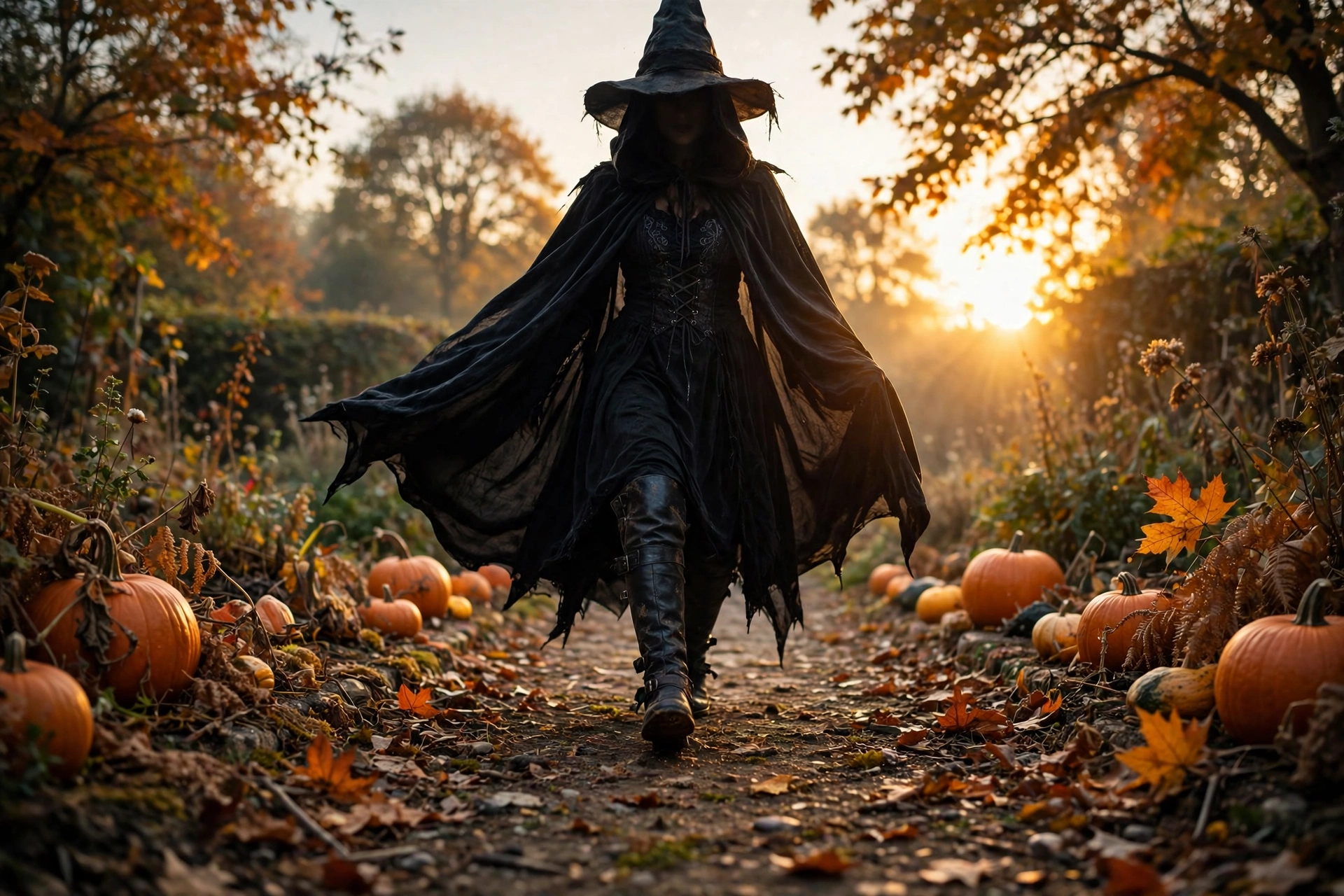
- A witch hat and a flowing skirt, filmed on a pavement at dusk
- A vampire cape that moves when you walk — movement is gold here
- A skeleton onesie with white trainers, played completely straight-faced
If your costume is mostly a mask or face paint, add one strong lower-half element: a cape, a long skirt, tall boots, anything that moves or catches light. Your legs are doing the opening act. Give them something to work with.
Step 2: Choose your location and light
Golden hour is your friend, but it’s not the only option. I filmed my decent version in a hallway at night with one lamp behind the camera and the hallway light off, and the shadows did half the work for free.
What you want is:
- A straight path toward the camera, at least 4 to 5 metres long, so you have room to walk slowly without running out of space
- A background that isn’t cluttered — a plain wall, a garden, a quiet street, a hallway all work better than a messy bedroom
- Light on your costume, not behind you — if the light is behind you, you become a silhouette, and the costume detail disappears
If you’re filming outside, dusk is ideal: the sky is still bright enough to see the costume, but dark enough to feel spooky. If you’re inside, one warm lamp aimed at you from near the camera works surprisingly well.
Avoid filming in a cramped space. I tried it in a tiny corridor first and had to take baby steps, which looked less like a creepy stalk and more like I was sneaking past a sleeping baby. You need room to stride.
Step 3: Set the camera low and lock it down
This is the single most important technical step.
Put the camera low — ankle to knee height — and keep it still. A tripod is ideal. No tripod? A stack of books on the floor, a shoe, a low stool, anything stable. A friend holding the phone can work too, but ask them to crouch and hold still rather than walking backward. Shaky backward-walking footage is the fastest way to make this look amateur.
Frame it like this: your feet and lower legs fill the bottom of the frame, with space above for the reveal. You want the camera to start on your legs and then either tilt up slowly or cut to a wider shot for the full costume. Both versions work:
- The tilt-up: one continuous shot where the camera slowly tilts up from your feet to your face as you approach. This feels the most cinematic, but it’s harder — the tilt has to be smooth.
- The pull-back cut: film the low leg shot first, then film a second wider shot of the full costume, and cut between them on the drum beat in CapCut. This is easier and more forgiving, and honestly, most of the versions going around use this one.
I used the pull-back cut. My tilt-up attempt looked like the camera was having a seizure. Know your limits.
Film in your phone’s highest quality setting, and if your phone offers it, lock the exposure by tapping and holding on your costume so the brightness doesn’t jump around as you walk toward the camera.
Step 4: Walk the walk (yes, practise it)
Stand at the far end of your path. Start recording. Wait a beat — a full second of stillness before you move actually helps, because it lets the viewer settle into the shot. Then walk.
Walk slower than you think. Keep your shoulders back, your face serious (or in character), and your eyes on the camera. Don’t smile at the start if you’re going for creepy — you can break character at the end if you want a funny payoff, but the walk itself should be committed.
Here’s the mistake I made on take two: I looked at my feet. Everyone does it. You’re worried about tripping, so you glance down, and suddenly you look nervous instead of menacing. Pick a spot just above the camera lens and walk toward it. Trust your feet.
Do at least three takes. The first one is always too fast. The second one is usually the one. The third one is your backup in case the second has a wobble.
Step 5: Edit it in CapCut
You don’t need anything fancy. Here’s the edit I used, start to finish in CapCut:
- Import your low leg shot first, then your full-costume shot.
- Trim the leg shot so it ends right on the drum hit in "Ramalama (Bang Bang)." If the sound isn’t available in your region or account type, add it in Instagram or TikTok after exporting, or use a drum-heavy alternative — don’t force a licensed track that your account can’t use.
- Place the cut between the two shots exactly on the beat. If the cut lands even half a second early or late, the whole thing feels off. Zoom into the timeline and nudge it until it feels right.
- Add a tiny slow-motion effect (0.8x or so) to the leg shot if your walk still feels rushed. Don’t overdo it — heavy slow motion looks dreamy, not creepy.
- Keep colour simple. A slight contrast bump or a cooler/warmer filter is plenty. I tried a heavy horror filter on my first edit and it made the costume look muddy. Less is more.
- Skip the text overlays, or keep them to one line at most. This format works because there’s nothing to read — the image does the talking. A caption like "Did I win this trend?" works well in the post caption itself, where it invites comments without cluttering the video.
Export in 1080×1920 (vertical), and check the exported file before posting. Watch it once with sound on and once with sound off. If it still reads without sound, you’ve got a strong video — most people scroll with sound off first.
Variations that keep it fresh
Once you’ve got the basic walk down, you can bend it without breaking it:
- The group walk: two or three people in costume walking in a line, one behind the other. The depth makes it look instantly bigger.
- The funny payoff: walk dead seriously for the whole shot, then break character right at the end — trip, wave, grin. The contrast gets comments.
- The pet cameo: a dog or cat walking alongside you in a tiny costume. I am not above this. It works every time.
- The location swap: film the same walk in two places — normal hallway, then spooky garden — and cut between them. Just keep the walk speed consistent or the cut jars.
- The before-and-after: start in normal clothes walking toward the camera, cut on the beat to the full costume. This is the closest cousin to the classic costume reveal, and it pairs well with the Ramalama walk because the slow pace makes the change feel bigger.
Pick one variation per video. I once tried group walk plus pet cameo plus funny payoff in a single 15-second clip and it looked like chaos. One idea, done well, beats three ideas fighting each other.
Common mistakes to avoid
Let me save you the takes I wasted:
- Walking too fast. Half speed. Always half speed.
- Camera too high. Chest height kills the effect. Get low, even if it feels silly.
- Looking at your feet. Eyes on the camera, or just past it.
- Filming in a cluttered room. The background competes with the costume. Clear it or move outside.
- Adding too much text. One line maximum, or none at all.
- Using a sound your account can’t access. Check the track in-app first, especially on a business account.
- Posting after Halloween. This is a seasonal format with a hard stop. The window closes on October 31, so if you’re going to film it, film it this week, not next month.
That last one matters more than people think. I have a folder of Halloween edits I finished on November 2 last year. Nobody watched them. Seasonal formats don’t age gracefully — they expire.
How this fits with the other Halloween formats
If you’ve already filmed a pumpkin head or a sheet ghost reel this month, the Ramalama walk is a natural third video because it uses the same skills — a phone, a costume, a bit of patience — but looks completely different on your profile. A feed with three different Halloween formats looks like a creator having fun with the season. A feed with the same joke three times looks like a creator out of ideas.
For reference, here are the related guides already live on this site:
- Pumpkin Head Illusion — the cheapest Halloween illusion going, and still the easiest to film.
- Things You Should Definitely Ghost — the sheet ghost sign reel, perfect if you want a joke format rather than a mood format.
- Upside Down Reels — a flip transition that works year-round, not just at Halloween.
- Crumpled Paper Reel — the wadded paper message trend, another one-shot format with a satisfying payoff.
- GRWM Loading Reel — the 0 to 100 percent makeup format, useful if your costume reveal starts with a getting-ready sequence.
- How to Increase Views on Reels — the retention and hook guide, worth a read before you post any of these.
Final thoughts
I went from dismissing this trend to genuinely liking it, and the reason is simple: it’s one of the few formats where the filming technique is the content. You don’t need a better costume, a bigger budget, or a cleverer joke. You need a low camera, a slow walk, and the patience to do three takes instead of one.
Film it this week, while Halloween is still the thing everyone’s talking about. Pick a costume that reads from the legs up, find a straight path with decent light, get the camera low, walk half as fast as feels natural, and cut on the drum beat.
And if your first take looks like you’re walking to the shop — congratulations, you’re exactly where I started. Take two is usually the one.
Frequently asked questions
What song is the Ramalama Costume Walk set to?
Róisín Murphy’s "Ramalama (Bang Bang)." The drum hit is what the costume reveal is timed to. Check availability in Instagram or TikTok before filming, since licensed track access varies by account type and region.
Do I need a tripod for the Ramalama Costume Walk?
No, but you need a stable low camera position. A stack of books, a low stool, or a friend crouching and holding still all work. The key is a low, steady angle — shaky footage breaks the cinematic feel.
How slow should I walk?
About half your normal walking speed. It feels unnatural while filming but looks deliberate on camera, and it gives the viewer time to take in the costume piece by piece.
Can I film the Ramalama Costume Walk indoors?
Yes. A hallway, a living room with furniture pushed back, or any straight path of 4 to 5 metres works. Put light on your costume from near the camera and keep the background uncluttered.
When should I post a Ramalama Costume Walk?
Before October 31. It’s a Halloween format, so its window closes at the end of the month. Posting in the last week of October catches people at peak spooky-season mood.
Does the Ramalama Costume Walk work for non-scary costumes?
Yes. Funny, glam, and group costumes all work, because the slow walk makes any costume look intentional. The mood comes from the pace and the camera angle, not just the costume itself.