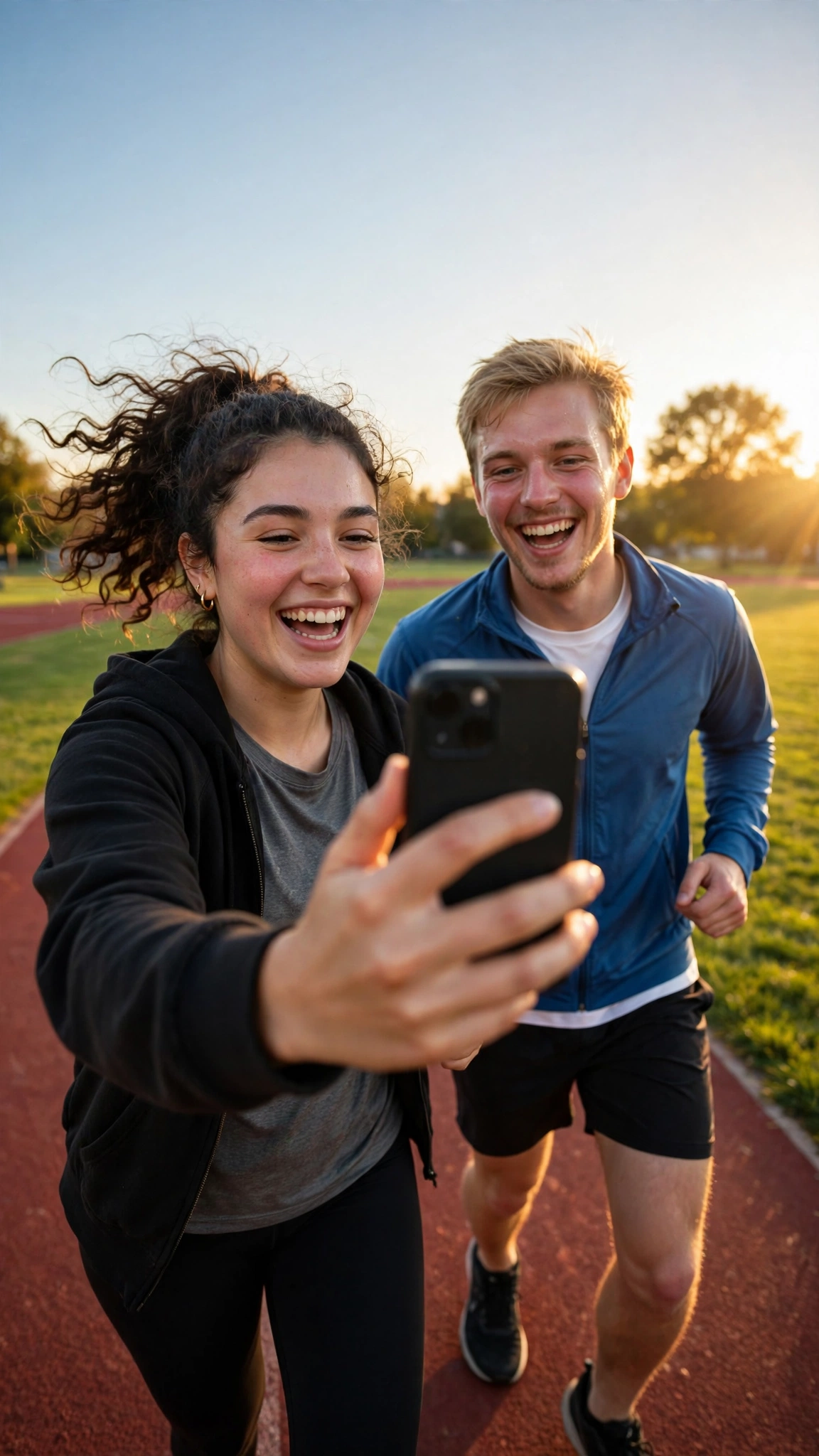
Run a lap until we say the same word showed up on my feed on a day I had absolutely no intention of running anywhere. Two friends were on a track, out of breath, shouting “pizza” and “Papa John’s” at each other after their fourth lap, and I watched the whole thing twice. Then I watched three more versions. Then I sent one to my friend with the message “we are doing this on Saturday.” That is how this trend works. It does not look like a trend. It looks like two people messing around at a park, and somehow that is exactly why people keep watching.
If you have been scrolling Reels or TikTok this week, you have probably seen a version of it. Two or three friends stand on a running track or in a park. They count down, each say a word, and if the words do not match, they run a lap and try again. They keep going until both of them say the same word at the same time. The rules are simple, the payoff is a small celebration when the words finally line up, and the comedy comes from how badly two people who claim to know each other can fail to think of the same word.
I filmed my own version last weekend with a friend who swore we would match on the first try. We did not. We matched on the sixth lap, both of us sweating, both of us laughing too hard to run properly, and the clip did better than most of the edited videos I posted all month. So here is everything I learned, including the mistakes that cost us good takes, so your version works the first time you film it.
What Is the Run a Lap Until We Say the Same Word Trend?
Run a lap until we say the same word is a friend-challenge format built on one rule: two people run a lap, then say a word at the same time, and they repeat the lap until the words match. That is the whole game. There is no template to download, no effect to apply, and no costume change. You need a track or a park path, a phone, and a friend who is willing to run.
The format usually starts with both people facing the camera. One of them explains the rule in a sentence or two, often as on-screen text instead of spoken words. Then they count down, three, two, one, and each say a word. A red X or a buzzer sound marks a miss. Then they run. While they run, the camera either follows them selfie-style or stays fixed while they jog away and come back. When they return, they try again.
The words are the fun part. In the versions going around right now, people start in a theme and slowly drift away from it as they get tired. One pair kept guessing food words: pizza, burgers, hot dogs, ketchup, mustard. Another pair, both runners, got stuck on GPS words: satellite, Strava, Garmin, location, pace, distance. A third pair tried history and ended up shouting about wars and video games before finally landing on the same console name after eight laps. The pattern is always the same. The first guesses are confident and logical. By lap four, the guesses are random, breathless, and barely connected to anything. That slide from logic to nonsense is what keeps people watching until the end.
The trend picked up properly in the first week of November 2026. New versions are appearing daily, from couples on running tracks to groups of three friends in autumn parks, and the format has already spun off into a “Part 2” for creators whose first video did well. It sits at the top of this week’s trending short-form lists alongside the “Trying to explain” trend and the “Friends” CapCut template, and unlike template trends, it does not depend on a link that can disappear. The game is the format.
Why This Trend Is Blowing Up Right Now
The first reason is that it is genuinely fun to watch, and that sounds obvious until you compare it with most trends. A lot of formats ask the viewer to admire something: a transition, an outfit, an edit. This one asks the viewer to play along. You hear the countdown, you pick a word in your head, and then you find out whether you matched. You are involved before the first lap is even over.
The second reason is the workout twist. Running makes everything funnier. People sound different when they are out of breath. Sentences come out in pieces. A word shouted between gasps lands harder than the same word said sitting on a sofa. The physical effort also gives the video a natural arc. Lap one looks fresh and confident. Lap five looks like two people questioning their life choices. That visible decline is a story, and stories hold attention.
The third reason is how easy it is to copy. You do not need editing skills, a ring light, or a trending audio. You need a friend and a place to run. When a format is that cheap to make, it spreads fast, because every version that does well inspires five more people to try it the same afternoon. That is exactly what happened this week.
And there is one more thing. The trend is kind. Nobody loses badly, nobody gets embarrassed on purpose, and the ending is always a small celebration. High-fives, shouting, sometimes a hug. In a feed full of pranks and roasts, a video that ends with two friends genuinely happy feels good to share.
What You Need Before You Film
You need less gear than you think, but a little planning saves you from the mistakes I made on my first attempt.
First, pick your partner carefully. The best partner is someone you actually know well, because the whole joke is that two people who know each other still cannot think of the same word. A stranger will give you polite, safe guesses. A close friend will give you weird, specific guesses, and weird and specific is what gets saved and shared. My friend and I have known each other for years, and we still took six laps. That is the point.
Second, pick your location. A running track is ideal because the lap is a real, visible loop, and the distance is the same every time. A park path works too, as long as the loop is clear and you can both see the starting point. Avoid busy roads, uneven ground, or anywhere you have to dodge people. I filmed my first version on a park path that crossed a dog-walking route, and we lost two good laps to a very friendly golden retriever. Funny in real life, useless on camera.
Third, decide your word strategy before you press record. This sounds like overthinking a silly game, and it is, but it is also the difference between a video that ends on lap three and one that drags to lap twelve. Agree on a starting theme, like food, or movies, or things in your house. Themes narrow the guesses and make the match come sooner. Without a theme, you are guessing from the entire dictionary, and the video can drag. But do not agree on the actual word in advance. That kills the game. Pick a theme, not an answer.
Fourth, sort out your filming setup. One phone is enough. A small tripod at the start line holds the wide shot while you run, or a friend can hold the phone and film you both selfie-style while jogging. If you film selfie-style while running, hold the phone steady with both hands and keep your elbows tucked in, or the footage shakes so much that nobody can read the text. I learned that on lap one. My first clip looked like it was filmed during an earthquake.
How to Film the Run a Lap Until We Say the Same Word Reel
Here is the exact process I used for the version that worked. It takes about half an hour including the running, and the edit takes another fifteen minutes in CapCut.
Step 1: Set up the opening shot
Stand at the start line with your partner, both facing the camera. Put the on-screen text up first, before anyone speaks: “Running a lap until we say the same word.” Keep the text big, white, and bold, with a dark outline so it reads over a bright sky. One of you says the rule out loud in a single sentence, something like “We run a lap, then we say a word, and we keep going until we match.” That is all the setup the viewer needs. Do not explain it twice.
Film this opening in landscape light if you can. Morning or late afternoon gives you soft light and long shadows, and the track looks good on camera. Midday sun makes everyone squint, and squinting does not read as funny. It reads as uncomfortable.
Step 2: Do the countdown and the first words
Count down together, “three, two, one,” and say your words at the same time. This is the moment people rewatch, so make it clear. Look at the camera when you say the word, not at each other. The viewer needs to hear both words cleanly, and if you turn away from the phone, your voice drops out.
After the words, react honestly. If they do not match, laugh, groan, or shake your head. Do not fake it. The reaction is the content. A big fake reaction looks staged and people scroll past it. A real groan after a near-miss keeps people watching, because they have felt that exact frustration.
Add a red X over each word on screen, or a simple “NOPE” in the edit later. Keep the text on screen for about a second so people can read both words before the running starts.
Step 3: Run the lap
This is where the format earns its views, so do not skip the running. Film at least part of each lap. If one person holds the phone selfie-style while jogging, keep the clips short, two or three seconds each, and cut between them. If the phone is on a tripod at the start line, film yourselves running away and coming back. Either way, show the effort. Heavy breathing, slow jogging by lap four, someone walking the last stretch. That is not a flaw. That is the video.
A practical tip: do not sprint. You need to be able to speak when you get back. My friend sprinted lap one to show off, came back gasping, and could not say a word for thirty seconds. We lost the take. Jog at a pace you can hold for six or seven laps, because you do not know how many laps this will take.
Step 4: Repeat until the words match
Each time you return, do the countdown again and say new words. Try to build on the last round instead of starting from scratch. If the last round was “pizza” versus “burger”, the next round should stay in food. If someone jumps to a random word from a different theme, the game gets harder and the video gets longer. That sounds like it would be funnier, and sometimes it is, but only for one extra lap. After that, the audience loses the thread.
When the words finally match, celebrate properly. Shout, high-five, hug, fall over if you want. The celebration is the payoff the viewer waited for, so give it a full two or three seconds on screen. Do not cut away the moment it happens. The best versions of this trend let the celebration breathe.
Step 5: Edit it in CapCut
Open CapCut and import your clips in order. Trim the dead time between laps so the video moves fast. A good target is 30 to 45 seconds total. Cut the walking, keep the running and the word reveals.
Add on-screen text for every word, big and readable, with a red X on the misses and a green check on the match. Add a lap counter in the corner, “Lap 1”, “Lap 2”, and so on, so viewers can track how long the game is going. It also builds suspense. When someone sees “Lap 6”, they stay to find out whether this is finally the one.
For audio, keep your real voices. The breathless delivery is half the joke, and muting it to add a trending song kills the format. If you want music, add a quiet track underneath at low volume, around 15 to 20 percent, so your voices stay clear. Export in 1080 by 1920, 30 frames per second, and check the captions before you post.
Word Ideas That Actually Work
If you are stuck on what to say, start with a theme and stay inside it for at least three rounds. Food works for almost everyone, because everyone has strong opinions about food. Movies work well for friend groups who watch the same things. Sports work if you both follow the same team. Hometowns, school memories, and everyday objects in your house all work too.
The trick is to pick words that are obvious inside the theme but not identical. “Pizza” and “burger” are a good miss, because they are close enough to feel like a near-win. “Pizza” and “quantum physics” is a bad miss, because it feels random and the audience stops playing along. Near-misses are funny. Random misses are confusing.
Some pairs use a clever strategy. They agree on a theme, then one person always picks the most obvious word in that theme while the other picks the second most obvious. It sounds like it should work instantly, and it almost never does, because two people rarely agree on what “most obvious” means. That disagreement is the video.
A word of warning: do not use the same word twice in a row hoping your partner will catch on. It reads as cheating, and the comments will say so. The game only works if both people are genuinely guessing.
Common Mistakes That Ruin This Reel
I made most of these on my first attempt, so learn from my laps.
The first mistake is running too hard. Sprinting looks impressive for ten seconds and then ruins the next three laps. Jog. You need your breath for the words.
The second mistake is filming somewhere noisy. A track next to a busy road, or a park full of shouting kids, drowns out the words. The words are the whole video. If people cannot hear them, they scroll. Pick a quiet spot, or film early in the morning when the park is empty.
The third mistake is making the video too long. If the game goes past eight or nine laps, cut the middle laps in the edit. Keep laps one, two, and the final match, and show the middle laps as quick one-second flashes with the lap counter. Nobody needs to see all nine attempts in full. They need to feel the effort, not count every step.
The fourth mistake is over-editing. This format does not need transitions, filters, or effects. It needs clear words, a visible lap counter, and honest reactions. The first time I edited mine, I added a zoom effect on every word reveal and a sound effect on every miss. It looked like a game show from the nineties. I stripped all of it out, and the clean version did far better.
The fifth mistake is faking the match. If you plan the matching word in advance, viewers can tell. The reactions are too clean, the timing is too perfect, and the comments will call it out. Let the game be real. If it takes ten laps, it takes ten laps. The real match is always funnier than a planned one.
Variations Worth Trying
Once you have the basic format down, there are a few versions going around that are worth trying.
The three-person version is the most popular. Three people run, three words get shouted, and the game only ends when all three match. It takes longer, so it works best with a tight theme, but the celebration at the end is bigger because three people finally agree on something.
The couples version works well too, and it has a different kind of humour. Couples who live together assume they think alike, and the video proves they do not. The comments on those versions are full of people tagging their partners, which is exactly the kind of engagement that pushes a Reel further.
The themed version is good for creators who want to stand out. Pick a theme that fits your niche, like gym words, cooking words, or movie titles, and stay inside it for the whole video. It makes the video feel crafted instead of random, and it gives people a reason to follow you for the next one.
And if running is not your thing, some creators are doing a walking version, or a version where they do ten jumping jacks instead of a lap. The rule stays the same. The effort just changes shape. Pick the version you can actually finish, because a video that ends halfway through a game nobody won is a video nobody finishes.
Frequently Asked Questions
How long should a Run a lap until we say the same word Reel be?
Aim for 30 to 45 seconds. That is long enough for four to six laps and a celebration, and short enough that people watch to the end. If your game runs longer, cut the middle laps to one-second flashes with the lap counter so the pace stays quick.
Do I need a running track to film this trend?
No. A track is ideal because the lap is a clear loop, but a park path, a quiet street loop, or even a large garden works. The important thing is that the loop is visible and safe, and that you both start and finish in the same spot every time.
What is the best word strategy for matching quickly?
Agree on a theme before you start, like food or movies, and stay inside it. Then each pick the most obvious word in that theme. Do not agree on the word itself. Near-misses inside one theme are funny, and they usually lead to a match within four to six laps.
Can I film this trend alone?
Not really, because the game needs two people guessing. You can film it with a friend over a video call if you are in different places, each running your own lap and shouting your word at the camera, but the in-person version works better because the reactions are real and the running is visible.
Should I add music to a Run a lap until we say the same word Reel?
Keep your real voices front and centre, because the breathless delivery is part of the joke. If you add music, keep it very quiet, around 15 to 20 percent volume, so the words stay clear. A loud trending song over the countdown will bury the words and the video will not work.
Does this trend need CapCut or any special editing?
No special editing is needed. CapCut is enough for trimming clips, adding on-screen text for the words, and putting a lap counter in the corner. The format works because the game is real, not because the edit is fancy. Keep the edit clean and let the laps do the work.
Final Thoughts
Run a lap until we say the same word is one of those trends that looks too simple to work, and that is exactly why it works. Two friends, a track, a countdown, and a game that anyone can understand in five seconds. No template, no effect, no budget. Just running, guessing, and laughing when it goes wrong.
My advice is simple. Pick a friend you actually know, agree on a theme, jog instead of sprinting, and let the game be real. Film the laps, keep the words clear, and do not over-edit it. The best version of this Reel is the one where two tired people finally say the same word and celebrate like they won something. Because after six laps, they kind of did.
Related Reads
I Do My Best Trend: How to Make the Relatable Effort Reel Everyone Is Posting in November 2026
YAP Format: How to Film the Raw Talking-to-Camera Reel Everyone Is Watching in October 2026
Take That Chance Reel: How to Make the Story Montage Everyone Is Posting in October 2026